How and why a saree worn during India’s Mangalyan mission ended up in top US museum
How and why a saree worn during India’s Mangalyan mission ended up in top US museum
The bureau represents a collective of experienced journalists, editors, and correspondents who work across television, digital, and social platforms to deliver timely, accurate, and wide-ranging news coverage. Zee Media Bureau's coverage spans politics, business, economy, technology, health, entertainment, and global affairs. The bureau follows a collaborative newsroom model, where stories are researched, verified, and published by a team. This ensures speed, editorial consistency, and adherence to journalistic standards, particularly for breaking news and developing stories.
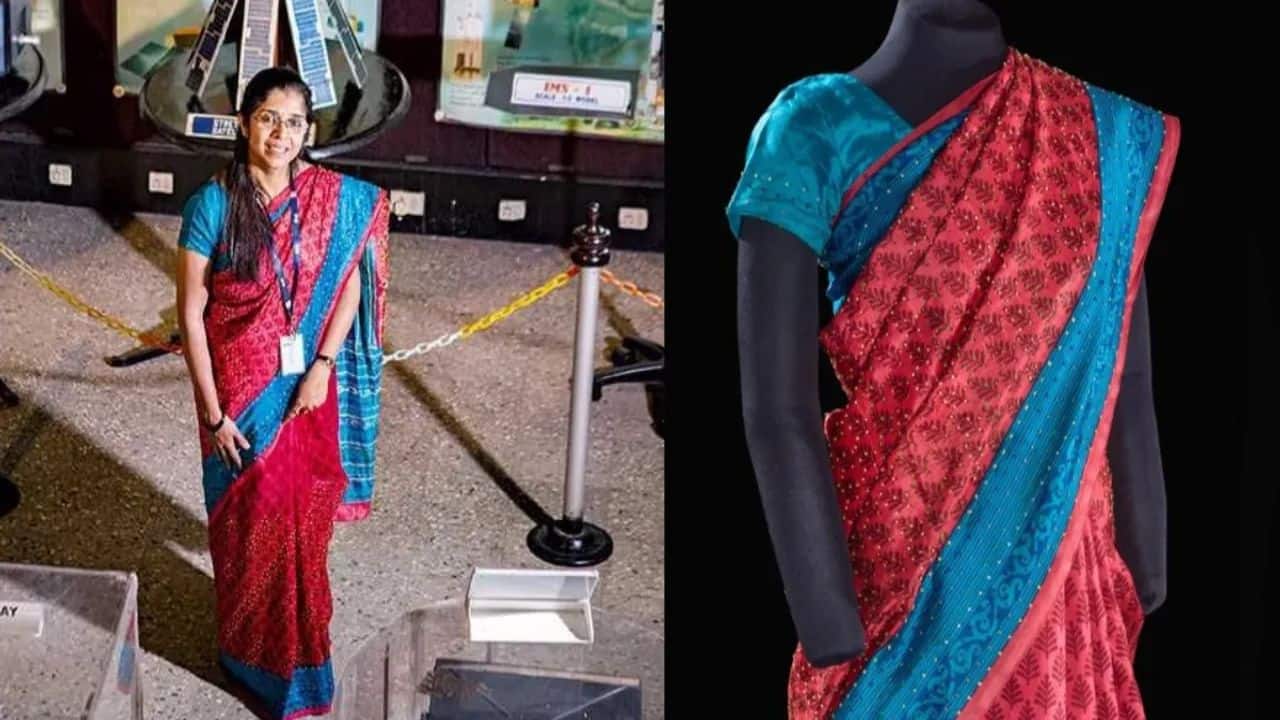
New Delhi: A bright red-and-blue silk saree worn during one of India’s proudest space milestones has found a new home thousands of kilometres away from where its story began. Once worn by Indian space scientist Nandini Harinath during a crucial phase of the Mars Orbiter Mission, the saree is now on display at the Smithsonian National Air and Space Museum in Washington, DC.
For her, the saree holds memories far beyond its fabric. It was one of several gifted to her by her father, and she often chose them for important occasions or when representing the Indian Space Research Organisation (ISRO). On December 1, 2013, she selected that same saree for a day that would prove decisive for India’s first mission to the mars.
Harinath served as the deputy operations director for the Mars Orbiter Mission, which is popularly known as Mangalyaan. Scientists, that day, had gathered in the control room for a critical operation that would send the spacecraft out of earth’s orbit and begin its nearly 300-day journey towards the mars.
Recalling the importance of that moment in an interview, she said, “It was a do-or-die moment. The mission’s most important operation was scheduled for that day. We had to decide when the spacecraft would go, how it would go and in which direction it would go. The success of the mission depended on what we did that day.”
The mission went on to make history. On September 24, 2014, the Mangalyaan successfully entered the mars orbit and made India the fourth country in the world to achieve the feat.
ALSO READ: Mangalyaan is non-recoverable and attained its end-of-life: ISRO on Mars orbiter mission
The achievement drew attention from across the world, and so did a photograph from the ISRO that showed women in sarees celebrating the success. The image went viral on social media and challenged the popular belief that India’s space programme was dominated entirely by men.
Later, the ISRO clarified that the women seen in the photograph were administrative staff members. The organisation also clarified that many women scientists had contributed to the mission and were present in the control room during critical operations.
Among those who saw the photograph was Matt Shindell, curator of space history at the museum. Speaking to a publication, he said the image left a strong impression on him.
“I thought people should know the story of these ‘rocket women’ who played important roles in this important mission,” he said.
In 2020, he reached out to Harinath by email. They soon began discussing what object could best tell the story of India’s mars mission and Harinath’s contribution to it.
“I asked her what she would be willing to donate to the museum. Eventually, we agreed on the saree she wore on the day Mangalyaan left the earth’s orbit,” he said.
Displaying the saree came with its own learning experience. Textile specialist Beth Knight watched YouTube tutorials to understand how a saree is worn before arranging it on a mannequin for exhibition.
ALSO READ: Mangalyaan: Built for 6 month-long mission, lasts for 8 years - Interesting facts about India's Mars orbiter
According to Shindell, the saree belongs in the same tradition as other historic pieces of clothing worn during landmark space missions. He compared it to the jacket worn by NASA flight director Gene Kranz during the Apollo 13 mission in 1970.
The Smithsonian attracts thousands of visitors every week and houses several objects from India. Most of them are related to Indian aviation companies or the Indian Air Force. The museum also preserves a silver commemorative plate gifted by the ISRO to science-fiction writer Arthur C. Clarke on his 90th birthday in 2007.
“This is the first object from India acquired for our interplanetary science collection. It is also the first saree in our collection,” Shindell said.
The saree is displayed in the museum’s ‘Futures in Space’ gallery along with toys, games, film posters and other objects that tell the story of humanity’s relationship with space. It is displayed next to the famous blue T-shirt worn by American astronaut Sally Ride during the 1983 Space Shuttle mission that made her the first American woman in space.
Shindell said the exhibition explores how people think about space exploration and its future. “There are many questions before us about space. The exhibition encourages people to think about who gets to go to space, who decides that, why we go there and what we will do when we arrive.”
📌 संबंधित खबरें
- खबर हटके- महिला अपना ही दूध पीकर पैसे बचा रही:हवा पर चलकर एथलीट ने चौंकाया; इनाम जीतने के लिए घोड़े की तरह दौड़े लोग
- "मां, अभी व्यस्त हूं बाद में आराम से बात करूंगा", कुछ घंटों बाद ही आ गई लेफ्टिनेंट शुभम कुमार की शहादत की खबर, अमर शहीद हुए जहानाबाद के लाल
- आम के पेड़ से चाहिए ज्यादा और वजनदार फल, तो तुड़ाई के बाद करें ये काम


टिप्पणियाँ
एक टिप्पणी भेजें